Last weekend I was back on Grounds at UVA, giving the keynote and judging at the HooHacks Ideathon, a one-day pitch competition where student teams go from a rough idea to a pitch in front of judges in about six hours. My main takeaway from the event was that students today have the same passion for creating things that I had, and far better tools for it. Watch out, world!
The organizers asked me to tell the story of theCourseForum, the course review site my friend Alan and I started in 2005 that is improbably still going strong today. I've told the origin story here before, so the short version: two roommates, the 7pm overnight train from Madrid to Paris, too little sleep and too much to talk about. Somewhere in the middle of the night, our conversation wandered to a question every student asks: which classes should I take? By the time we got to Paris, we had wireframes. And by the time the fall semester rolled around, we had launched the site.
Preparing a talk about something you did 20 years ago turns out to be a good excuse to figure out what you actually learned from it. Here's where I landed.
A lens: storyteller and scientist
One of the most important things you can do when creating something new is to answer, as clearly as possible, the question what am I building, and why? That's because your primary job is to get humans to change their behavior: users to buy your thing, colleagues to align on a vision, investors to back you.
The framework I've developed over my career for doing that (which I first wrote up in a post comparing product managers to underpants gnomes) goes like this: think like a storyteller, act like a scientist.
Storytellers are obsessed with people's motivations. What do my characters want? What's getting in their way? How do I weave all of that into a story that's coherent, and ideally a little inspiring?
Scientists are searchers too, but with a process. What's my hunch? Can I state it as a hypothesis? How would I test it? What did I learn, and what do I try next?
You need both. A story with no evidence is just a nice story. Evidence with no story is a spreadsheet nobody reads. Put them together, and you have something people can believe.
Back in 2005, we didn't have this slogan. We did a lot of it by instinct. Some of it we got right, and some of it we got very wrong.
What we got right
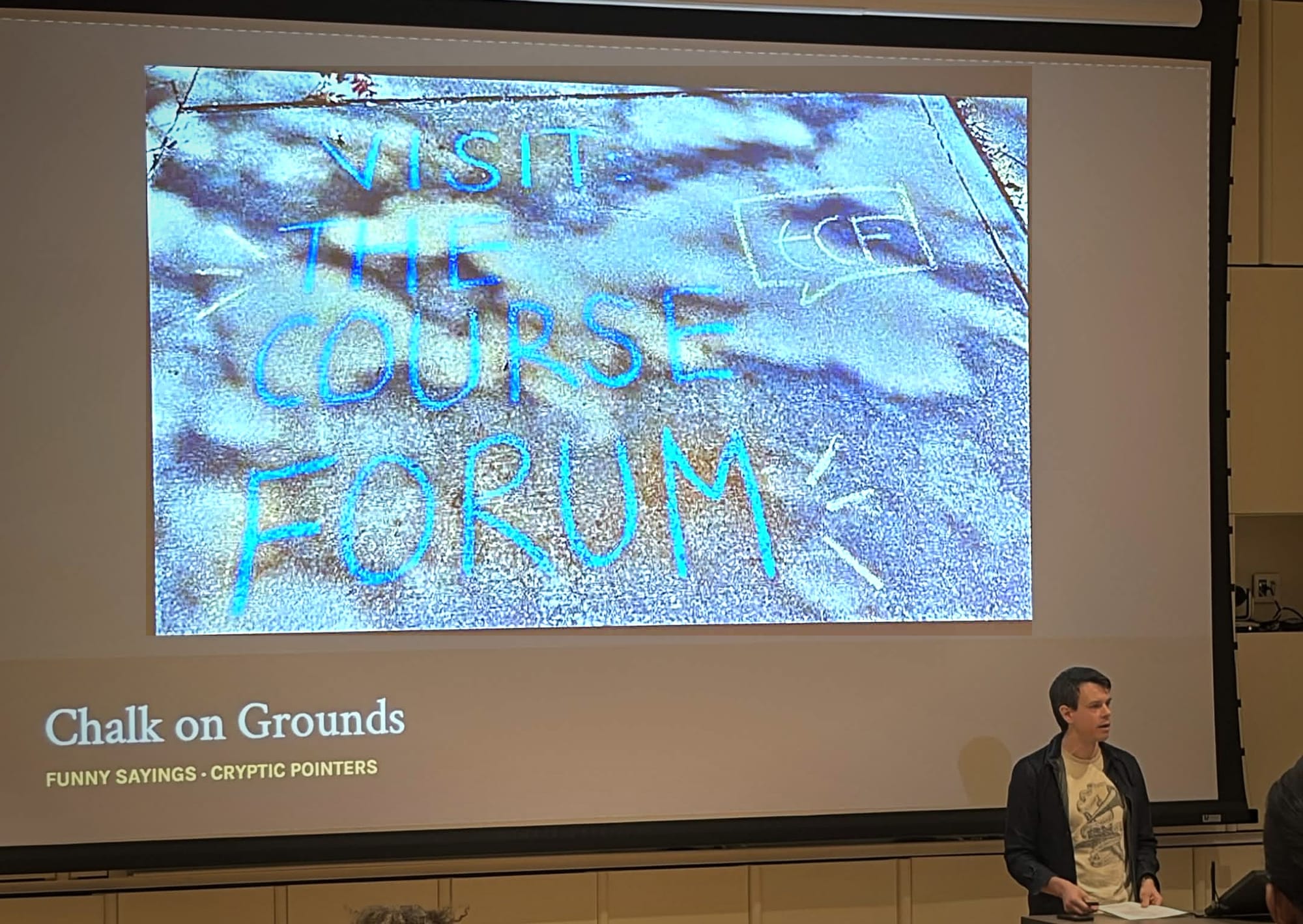
The storyteller half: make people curious. We had no budget and no marketing plan, but we did have friends willing to help. So we went out at night and chalked the sidewalks around Grounds with funny sayings and cryptic little pointers to the website. No explanation, just enough to make you wonder what on earth "theCourseForum" was. This was before the iPhone existed, so it had to stick with you until you got back to your computer. From the get-go, we were trying to put ourselves in the minds of our users.
The scientist half: test the hunch. After the initial spike of engagement, we kept building, but somewhat aimlessly, and adoption slowed. We developed a hunch that we needed something students would be wowed by: something helpful that they weren't asking for yet, because they didn't realize it was possible. Of all the ideas on our list (a schedule planner, graduation requirements, a textbook exchange), the one that stood out was grade distributions, which weren't available to students at the time.
The obvious question was how to get the data. A friend told us that because UVA is a public institution, we might be able to get it through a Freedom of Information Act request (little did I know I'd one day be on the receiving end of these as a federal employee). But as we were starting that process, we learned there was an office on the outskirts of Grounds that managed course data. So we walked over and knocked on the door. A guy named George had Excel files with grade distributions, got a kick out of our audacity, and decided to help.
That's still one of my favorite lessons from the whole thing: sometimes the cheapest, fastest experiment you can run is just being willing to ask.
The hunch was right. Grade distributions were the breakthrough, and the site took off.
What we got wrong
TheCourseForum almost didn't make it, because we never thought much about anything beyond the product itself.
The site went down multiple times while we were students, including once during course selection, the busiest week of the year. I was at a party when I got the call, so I headed home and debugged the site while…let's just say not entirely sober. I fixed it, but it wasn't much of an incident response plan.
When we graduated, we didn't have much of a transition plan either. We got lucky and found a second-year student, William Reynolds, who agreed to take up the mantle at the last minute. William did an admirable job and even came up with the tagline that's still on the site today: "connecting you to the courses you love." But when he graduated, there wasn't a strong succession plan, and the site went down again during course selection with nobody left to fix it.
We had built a great product, but we hadn't built anything to keep it alive.
What actually kept it alive
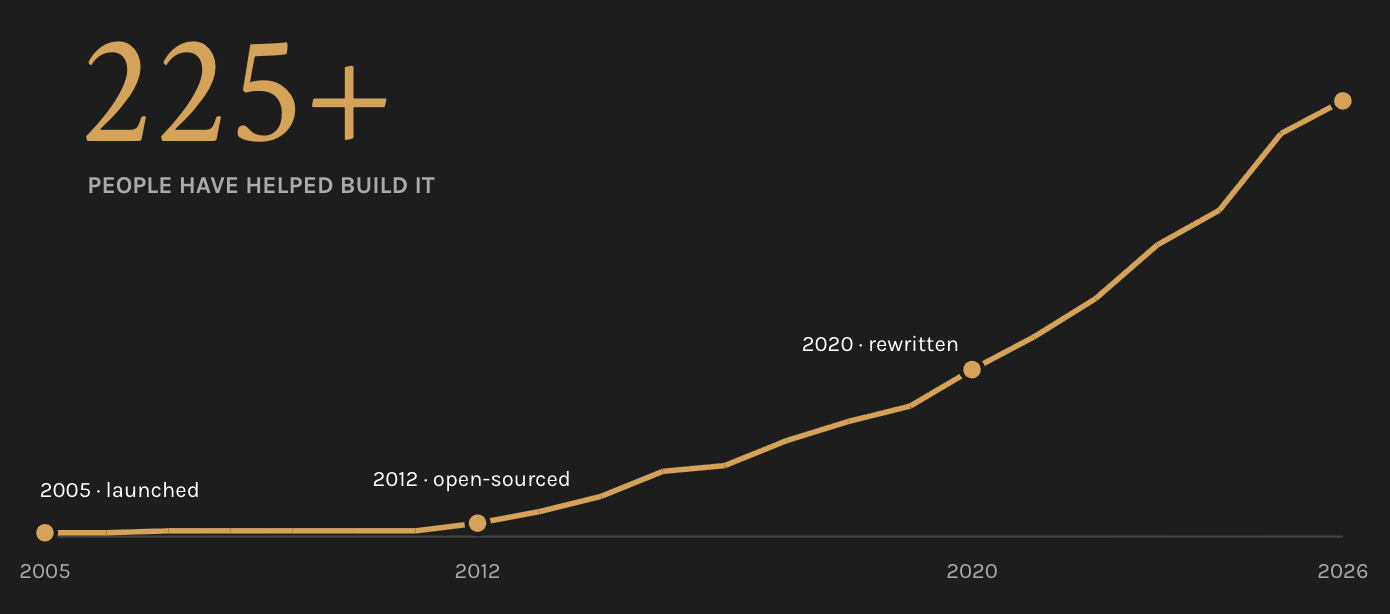
Thankfully, that's not where the story ends. In 2012, Class Council reached out to me about reviving it, and this time, instead of handing the site to one person, we turned it into an open-source project with a group around it. It started at a local hackerspace called HackCville (later Forge), and over time it became an official UVA student organization.
For years, two or three of us had worked on it. After 2012, the number started climbing. In total, more than 225 people have contributed code to the project, and hundreds more have contributed their time, energy, and skills in design, marketing, data, and other areas.
Part of what keeps it going is how it's framed. It isn't just a course review site anymore. It's a community of people working on something together, a place where students learn to build real software, and something that looks pretty good on a resume. Beyond that, the team actively recruits incoming students through other groups on Grounds.
At 20, I thought the product was the whole thing, and that if you built something good enough, the rest would take care of itself. That wasn't true then, and it's even less true now. With AI coding tools, the cost of building something is dropping fast. When anyone can build it, the product isn't the hard part anymore. The hard part is everything around it.
Why this, and why you?
George Lois (no relation to grade-distribution George) said that creating great work is 1% inspiration, 9% perspiration, and 90% justification. I'm not sure I fully buy that mix, but it underscores how much of the work is crafting the story that goes along with the work.
I left the students with three questions, which I think apply just as well to anyone with a new idea:
- Motivations: Who will buy your thing, and what do they care about? Not "everyone." A real person, with a real problem.
- Framing: How will you explain the value of what you're doing to those people in one or two sentences? If you can't, no one else will be able to either.
- Evidence: What data points or stories can serve as the foundation? You don't need proof yet, but you need to show you know what you'd have to prove.
On that train in 2005, Alan and I weren't building anything. We didn't have a company or a business plan. We were just two people talking through a problem that bugged us and sketching ideas on paper. That's exactly what those students were about to do, and what I hope anybody reading this with an idea will do too. TheCourseForum is evidence that something you sketch today could still be around in 20 years.
Judging that afternoon, I came away impressed. In about six hours, teams went from a blank page to pitches with a clear customer, a crisp story, and a real sense of what they'd need to prove next. Nothing like HooHacks existed when Alan and I were students, and I wish it had; we would have learned a lot of these lessons years sooner.
Many thanks to the HooHacks team for having me, and to everyone who has kept theCourseForum going all these years. Here's the deck from the talk.
In the spirit of pitch day, and a project that refused to end...